There is a quiet, exhausting crisis happening inside the modern workspace, and it has nothing to do with supply chains, remote work logistics, or macroeconomics.
It is the crisis of the operational autopilot.
Over a thirty-year career directing creative strategy for global brands—sitting in the boardrooms, pitching the campaigns, and winning accolades like the Cannes Lions—I watched a devastating pattern repeat itself. Organizations spend millions of dollars optimizing their processes, streamlining their workflows, and auditing their efficiencies. But in the pursuit of a flawless machine, they accidentally achieve something far more dangerous: they optimize the humanity right out of the building.
Teams stop taking risks. They fall back on safe, defensive scripts to protect their silos. They run on pure, numbing momentum.
When a company realizes it has stalled, the standard response is to hire a traditional consulting firm. But traditional consultants only know how to look at the machine. They rearrange the org chart, hand over a massive deck of sanitized slides, and walk away—leaving the underlying human stagnation completely untouched.
You cannot solve an energetic, deeply human problem with a structural schematic.
That is why I am launching a new path: The Social Artist in Residence.
Returning to the Source
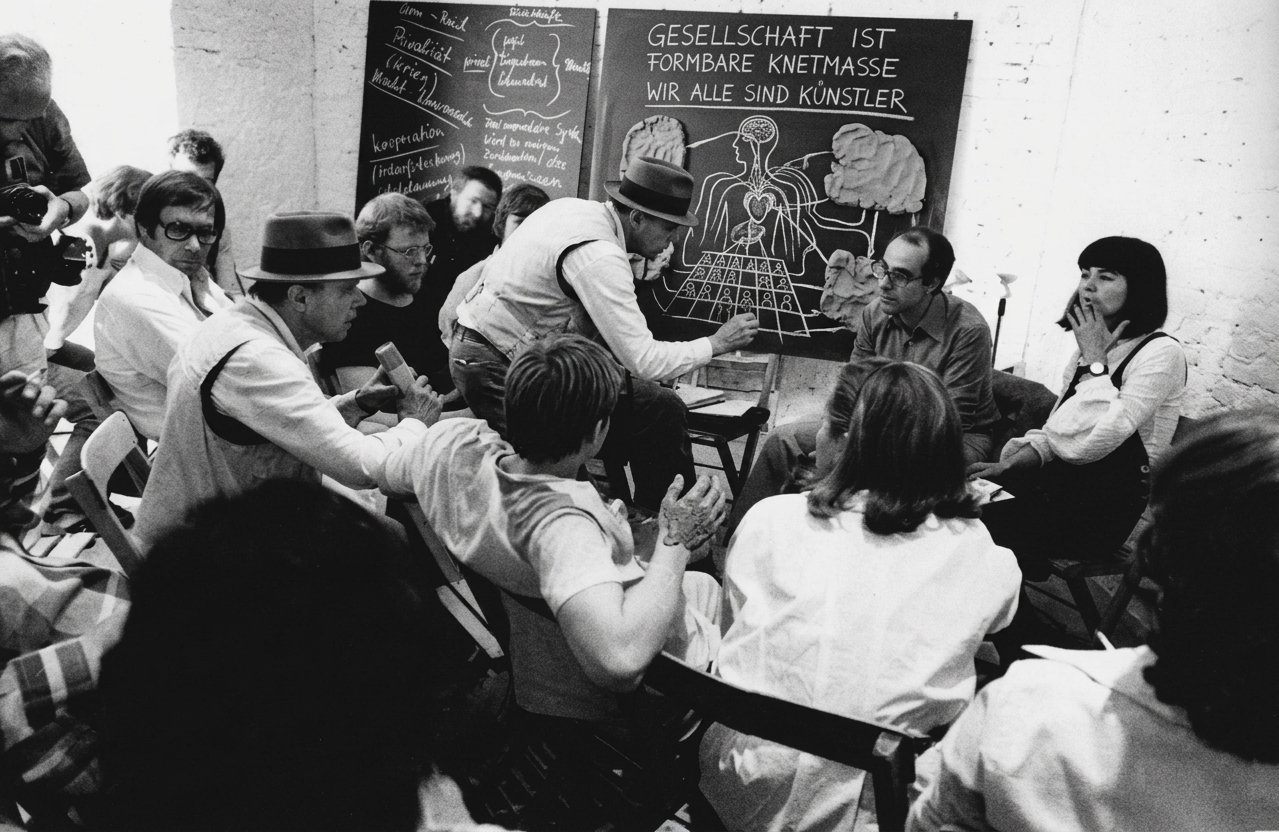
Long before I entered the global advertising machine, my foundational DNA was shaped at the San Francisco Art Institute. It was there that I absorbed a radical concept championed by the conceptual artist Joseph Beuys: Social Sculpture.
Beuys famously asserted that everyone is an artist, meaning that human society itself is the ultimate collaborative work of art. The structures we build, the languages we speak, and the way we interact are not unchangeable laws of nature—they are clay. They can be consciously molded, shaped, and transformed.
For the past three decades, I used that perspective to build commercial campaigns. Now, I am turning that artistic lens back onto the machinery of business itself.
I don’t look at a corporation as a blueprint or a spreadsheet. I look at it as a living, breathing social sculpture.
The AuDHD Edge: Seeing the Invisible
People often ask how an artist who proudly claims an AuDHD mind navigates the rigid corporate world. The truth is, it is my absolute superpower.
Because my brain is wired for high pattern recognition, deep empathy, and an insatiable, hyper-curious drive to understand how things connect, I don’t see what a neurotypical or linear consultant sees. I don’t just hear the words spoken in a meeting; I see the invisible rules holding people back. I notice the subtle cultural friction, the unspoken anxieties, and the defensive scripts that people use to mask their true creative intelligence.
Add to that a life lived across multiple cultures and the ability to think and create across four languages, and my entire worldview becomes one of translation. I know how to translate radical, unconstrained creative impulses into concrete operational realities that executives can actually use.
This Is An Intervention, Not a Workshop
The Social Artist in Residence is a 30-day embedded experiment. I don’t walk in with a predetermined framework or an academic manifesto.
Instead, I use my presence as a catalyst:
- I observe quietly to audit the invisible blocks holding your talent hostage.
- I disrupt actively by stepping into your daily workflows, injecting deliberate creative friction, and forcing lateral brainstorming sessions that shake teams out of their operational trance.
- I leave behind tangible artifacts—from custom-built, collaborative AI agent workflows to strategic White Papers detailing the raw, unproduced ideas sparked during the residency.
We have built a culture that treats humans like data points, and we are surprised when the innovation dries up. It’s time to stop managing the stagnation. It’s time to pick up the clay and start sculpting the future of how we work.
Leave a Reply